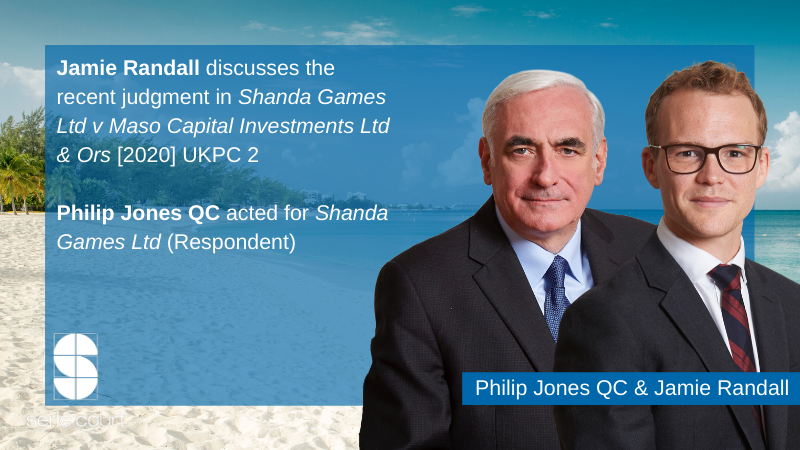
Jamie Randall discusses the recent judgment in Shanda Games Ltd v Maso Capital Investments Ltd & Ors [2020] UKPC 2
Under Part XVI of Cayman Island Companies Law, the merger of two companies can be effected by a special resolution of the members. However, the Companies Law also provides that any shareholder who dissents to the proposed merger is entitled to payment of the fair value of his shares. If the company and shareholder do not agree upon the price to be paid, it is left to the Court to determine the fair value. The principal question for the Privy Council in Shanda Games Ltd v Maso Capital Investments Ltd & Ors [2020] UKPC 2 was whether, when determining the fair value, a discount should be applied to reflect the fact that it was a minority shareholding.
Shanda Games Ltd was a company incorporated in the Cayman Islands with American Depository Shares listed on the NASDAQ. In 2015, on the passing of a special resolution, Shanda merged with Capitalcorp Ltd so that it could be taken private. A group of shareholders known as the Maso Parties, representing 1.64% of the issued share capital, dissented from the merger and the Court was subsequently required to determine the fair value of their shares under section 238.
At first instance it was held that no discount should be applied. The Judge’s decision was heavily influenced by the fact that in other jurisdictions, particularly Delaware (one of the models for the Cayman Islands’ statutory merger scheme), the basis for valuation was a pro rata share of the value of the company. In his judgment fair value meant the value as if there had been a sale or other realisation of the business as a whole and not as if there had been a sale of the particular shareholding.
The Court of Appeal of the Cayman Islands allowed Shanda’s appeal and held that a minority discount should be applied. In the Court of Appeal’s judgment, section 238 had to be interpreted consistently with other provisions of the Companies Law, in particular those dealing with schemes of arrangement and the acquisition of outstanding shares after an offer which had achieved 90% acceptance.
The Privy Council agreed with the decision of the Court of Appeal for three principal reasons:
- under comparable provisions of the Companies Law and equivalent UK provisions (namely schemes or arrangement and “squeeze-outs”) the Court will in effect approve a value which reflects the minority shareholding;
- the general principle of determining fair value is that the Court should value what the shareholder actually has to sell and not some hypothetical share (principally relying on Short v Treasury Commissioners [1948] 1 KB 116); and
- it could not be said that the Cayman Island legislature must have intended fair value to mean the same as in Delaware and, although Delaware jurisprudence was of relevance, it was not determinative and was outweighed by the previous two points.
The decision provides welcome guidance on a contentious issue in the Cayman Islands, as well as in other jurisdictions that have adopted similar schemes requiring the Court to appraise the value of shareholdings.
Please click here to view the judgment.
Philip Jones QC acted for Shanda Games Ltd (Respondent)
Author, Jamie Randall.
Related Barristers

Philip Jones KC
Call: 1985
Silk: 2006
Jamie Randall has a practice spanning a wide range of disputes concerning commercial and personal interests, and frequently the interconnection between the two. His recent trust and probate work covers the full spectrum of traditional chancery proceedings, including claims for breach of trust, accounts and removal of trustees, proprietary estoppel, 1975 Act claims, and probate disputes. Those cases often have an international element and he has acted on cases in numerous jurisdictions, including Jersey, Guernsey, Singapore, The Bahamas and Bermuda. His commercial work often includes claims for breach of fiduciary duty, deceit, unfair prejudice and insolvency-related issues.
Prior to coming to the Bar, Jamie worked in strategy consulting focused on the financial services sector. He approaches cases with pragmatism and always maintains a focus on the commercial outcome for clients. He also still enjoys being able to apply his financial experience to complex claims concerning valuation and forensic accounting issues.

Jamie Randall
Call: 2017